Blog
How to Write a Check in the Philippines: Format, Amount in Words, and Samples
Writing your first check can feel intimidating because every detail needs to be clear. But once you know what each field is for, the process is simple: add the date, payee name, amount in figures, amount in words, and your signature.
The most important rule is to make sure the amount in numbers matches the amount in words. Follow the date format printed on your check, write clearly, and avoid extra symbols in the amount box.
Use this guide as a step-by-step checklist. It shows you the basic check format in the Philippines, how to write peso amounts with centavos, and sample entries you can compare with your own check.
What a check is and when people still use it
When you issue a check, you ask your bank to pay money from your account to another person or business.
People still use checks for payments like rent, supplier transactions, loan payments, condominium dues, and other situations where a clear paper record is helpful. You may also receive a check and need to deposit or endorse it.
If any detail is unclear or incomplete, your bank may return the check. Reviewing it carefully before signing can help prevent delays.
Check formats in the Philippines
Before you start writing, it helps to know the main fields you will see on most checks especially if you're in the Philippines. The layout may differ by bank, but these are the usual parts:
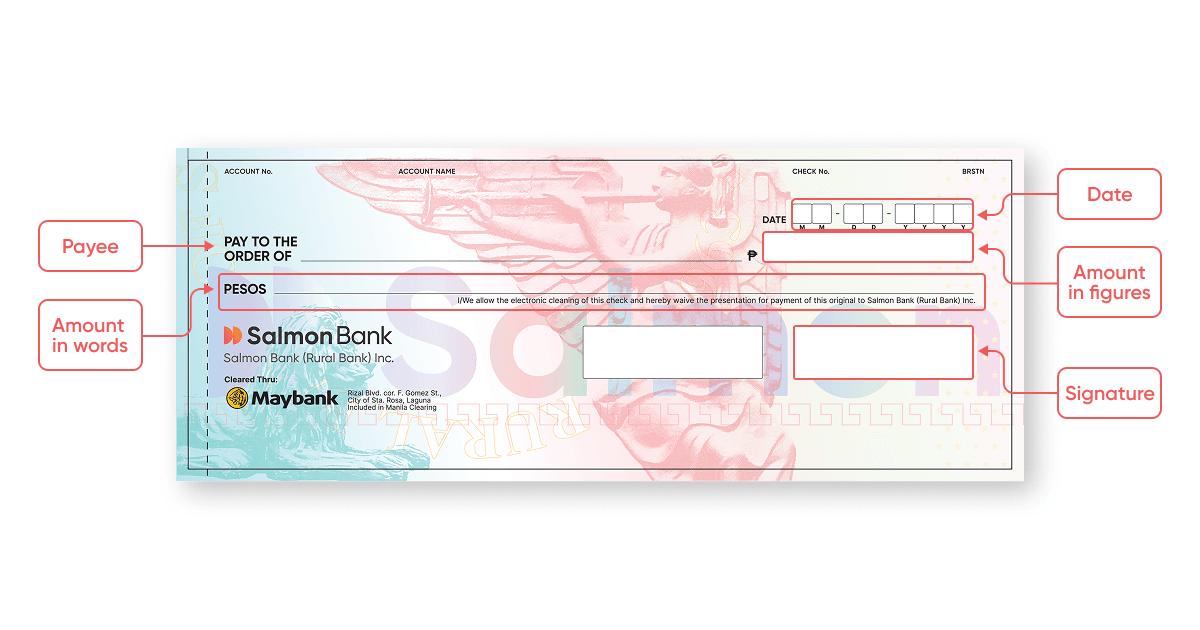
Field | What it is for |
Date | Shows when the check is issued |
Payee | Shows who should receive the money |
Amount in figures | Shows the amount in numbers |
Amount in words | Shows the same amount written out |
Signature | Confirms that you authorize the payment |
Your bank reviews these details together. If one detail is missing or does not match the others, the bank may reject the payment or delay the clearing process.
During clearing, banks verify and settle the payment that was made.
How to write a check step by step
Once you know the different fields, filling out a check becomes much easier. Just follow this simple step-by-step guide before you sign.
Step 1: Write the date
Start with the date. Look at the date boxes on your check and follow the order shown there.
If your check shows MM-DD-YYYY and the date is June 15, 2026, write: 06-15-2026
Use numbers only if the check asks for a numeric date. Many current bank advisories show dashes as the separator, so do not use slashes, dots, or a written-out month, such as June, unless your bank gives a different instruction.
When in doubt, follow the date format on your check and your bank’s latest instructions.
Step 2: Write the payee name
Next, write who will receive the payment. The payee is the person or business receiving the money. On this line, write the full name of the recipient clearly.
Examples:
Maria Dela Cruz
ABC Trading Corporation
For a business, ask for the correct registered name. Avoid nicknames or shortened names unless the payee’s bank account uses that name.
Be careful with checks payable to cash. Anyone holding a check made out to cash may be able to deposit or encash it, depending on bank rules. For safer payments, write the exact name of the person or business.
Avoid unclear payee names such as:
Maria Dela Cruz or Cash
ABC Trading Corporation and/or Cash
These may cause problems when the bank processes the check.
Step 3: Write the amount in figures
After the payee name, write the amount in figures. This is the amount written in numbers, usually inside the amount box.
For ₱15,250.75, write:15,250.75
Use commas for thousands and a period for centavos. Do not add a peso sign, asterisks, dashes, plus signs, or extra words inside the amount box unless your bank specifically tells you to. If the check already has the peso symbol beside the box, write only the number.
Step 4: Write the amount in words
The amount in words is the amount written out. This helps your bank confirm the exact amount you want to pay.
For ₱15,250.75, write: Fifteen thousand two hundred fifty pesos and 75/100 only
Write the same amount shown in the amount box so both parts of your check agree.
Step 5: Sign the check
Take one final look before you sign. Check the date, payee, amount in figures, and amount in words. Use the same signature your bank has on record. Do not sign a blank check. Your signature should be the last thing you write.
How to write the amount in words in a check in the Philippines
The amount in words is the part many people double-check, and for good reason: it must match the amount in figures. The easiest way to handle this part is to write the full peso amount first, then add the centavos if there are any.
Whole peso amounts
For ₱1,000.00, write:One thousand pesos only
For ₱12,500.00, write:Twelve thousand five hundred pesos only
For ₱100,000.00, write: One hundred thousand pesos only
Adding only shows that the amount ends there. Some bank advisories say a check without it may still be acceptable, but including it is still a good habit.
Amounts with centavos
To write centavos in a check in the Philippines, you can write the centavo amount over 100.
For ₱2,350.50, write:Two thousand three hundred fifty pesos and 50/100 only
For ₱10,000.25, write: Ten thousand pesos and 25/100 only
You may also write the centavos in words: Two thousand three hundred fifty pesos and fifty centavos only
Either format can work, as long as the amount is clear and matches the amount in figures.
How to write a check amount in words with centavos
In the Philippines, checks usually use centavos, not cents. If you need to know how to write a check amount in words with cents in the Philippines, read cents as centavos.
For ₱125,430.75, write: One hundred twenty-five thousand four hundred thirty pesos and 75/100 only
For ₱1,250,000.00, write: One million two hundred fifty thousand pesos only
If the amount is long, break it down first:
Millions
Thousands
Hundreds
Pesos
Centavos
Then write the full amount in one line.
Check sample in the Philippines
Here is how those fields can look when filled out together.
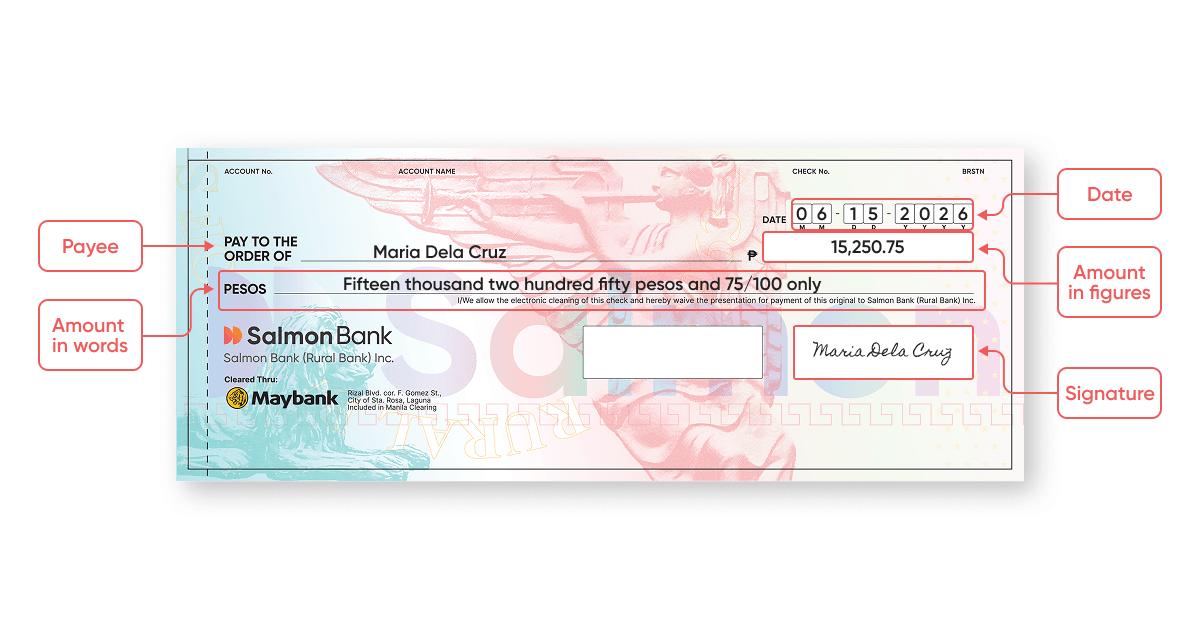
Check field | Sample entry |
Date | 06-15-2026 |
Payee | Maria Dela Cruz |
Amount in figures | 15,250.75 |
Amount in words | Fifteen thousand two hundred fifty pesos and 75/100 only |
Signature | Your usual bank signature |
In this example, you are paying Maria Dela Cruz ₱15,250.75.
The amount box says:
15,250.75
The amount in words says:
Fifteen thousand two hundred fifty pesos and 75/100 only
Because the two amounts match, the bank can read your payment clearly.
Track payments easily in a separate account
Use a Salmon Bank (Rural Bank) Checking account for rent, business and loan payments, and other transactions that need a clear record. Open an account
The new check format in the Philippines
For most people, the new check format in the Philippines is simple: write on each field clearly and follow the format printed on your check.
The Philippine Clearing House Corporation, or PCHC, sets standards for check clearing and check design. For everyday check writers, PCHC check guidelines mainly affect how you write the date, payee, amount in figures, amount in words, and signature.
These rules matter because banks need to read and process check details without confusion.
Date format
Use the date format printed on your check. If the boxes show MM-DD-YYYY, write the date in that order.
Example: 06-15-2026
Do not write June 15, 2026 if the check asks for numbers only. Do not write 06/15/2026 if your bank requires dashes.
Amount in figures
Write the amount as a number only.
Correct: 25,000.00
Avoid:
₱25,000.00
***25,000.00***
25,000.00 only
The amount box should be clean and easy to read. Avoid adding symbols, extra marks, or words unless your bank specifically tells you to.
Clear payee name and amount
Write one clear payee name. Avoid mixing a person or business name with or Cash or and/or Cash, because this may cause problems when the bank processes the check.
If the amount in figures includes centavos, include centavos in the amount in words too.
How to write at the back of a check
Banks usually use the back of a check for endorsement. An endorsement means the payee or depositor signs or writes the details the bank requires before deposit or encashment.
If you are issuing the check, you usually do not write anything at the back.
If you received the check and need to deposit it, your bank may ask you to sign at the back. Some banks may also ask for your account number or the words For deposit only.
A common deposit endorsement may look like this:
For deposit only to Account No. [your account number]
[Your signature]
Follow your bank’s instructions. Do not add extra notes or markings that are not required.
Common check writing mistakes to avoid
Most check errors are easy to avoid if you review the check before signing. Before you hand one over, take a minute to check these common mistakes.
1. The two amounts do not match
If the amount box says 10,500.00 but the amount in words says Ten thousand pesos only, the check is unclear.
Write:
Ten thousand five hundred pesos only
Both fields should show the same amount.
2. The payee name is unclear
A misspelled or incomplete payee name can delay the payment. For businesses, use the registered business name.
3. The date format is wrong
Use the same date format shown on your check. If the check asks for numeric dates with dashes, use that format.
4. The amount box has extra symbols
Avoid extra symbols, words, or markings in the amount box. Write the amount in figures clearly.
5. The check has erasures or heavy corrections
If you've made a mistake, check with your bank on how to void the check properly, then issue a new one. Do not try to fix mistakes by writing over them.
6. You signed the check before filling it out
Do not sign a blank check. Fill in all required fields first, review the details, then sign.
7. The check details are unclear
Your bank may not accept your check for clearing if it cannot process the details clearly or safely. If you are unsure about a correction, format, or endorsement, ask your bank before issuing or depositing the check.
What happens if a check is incorrect or bounces
If you fill out a check incorrectly, your bank may return it or reject it for clearing. This can delay your payment.
Your check may also bounce. This means the bank does not pay the check. Common reasons include insufficient funds, a closed account, a stopped payment, an invalid date, a signature issue, or a mismatch between the amount in figures and the amount in words.
If your check bounces, the payee may not receive the money on time. Your bank may also charge fees, depending on its rules. If the issue becomes a dispute, speak with your bank or a qualified legal professional.
Take note this article is a general guide and should not be treated as legal advice.
What to review before issuing a check
Before you sign, take one last look at the details on your check. Confirm that the date follows the format shown, the payee name is complete and spelled correctly, and the amount in figures matches the amount in words. If the amount includes centavos, make sure the written amount includes them too.
Also check for erasures, unclear marks, or missing details. Make sure your account has enough funds before you issue the check. Once everything looks correct, sign it. For your own records, note the check number, date, payee, and amount.
See your checking account options. Open a Salmon Bank (Rural Bank) Checking account and discover our latest checkbook options and eligible account privileges. Learn more
Frequently asked questions (FAQs)
How do you write a check in the Philippines?
Write the date, payee name, amount in figures, amount in words, and signature. Use the date format printed on the check, and make sure both amounts match before you sign.
What is the correct check format in the Philippines?
The basic check format in the Philippines includes the date, payee, amount in figures, amount in words, and signature. Current bank advisories also remind customers to use clear numeric dates, amount boxes without extra symbols, clear payee names, and matching amounts.
How do I write the amount in words on my check?
Write the peso amount first, then add the centavos if needed. For ₱12,345.67, write:
Twelve thousand three hundred forty-five pesos and 67/100 only
The written amount should match the amount in figures.
How do I write centavos on my check?
Write the centavos as a fraction over 100.
For ₱5,000.25, write:
Five thousand pesos and 25/100 only
You may also write:
Five thousand pesos and twenty-five centavos only
Can I write cents on a check in the Philippines?
Yes, but Philippine checks usually use the term centavos. Write the peso amount first, then the centavos, such as one thousand two hundred fifty pesos and 50/100 only.
What date format should I use on my check?
Use the date format printed on your actual check. If the boxes show MM-DD-YYYY, write June 15, 2026 as 06-15-2026. Use the separator required by your bank.
What should I write at the back of my check?
If you are depositing a check, your bank may ask you to sign at the back. Some banks may also ask for your account number or for you to write For deposit only. Follow your bank’s instructions before writing anything.
What can make my check unacceptable for clearing?
Your bank may treat your check as unacceptable for clearing if it cannot read or process the details safely. Common causes include writing a wrong date format, unclear payee name, mismatched amounts, missing signature, extra symbols, or unclear corrections.
13.07.2026