Blog
What Is the 50/30/20 Rule?

The 50/30/20 rule is a simple budgeting method that divides your take-home pay into 3 parts: 50% for your needs, 30% for wants, and 20% for your savings and future goals.
It gives you a clear starting point for a budget you can actually follow, especially if your income also has to cover rent, groceries, transport, tuition, debt, or family support.
For many people in the Philippines, the exact split may not fit right away. Use the 50/30/20 budget as a guide, then adjust it based on your actual monthly expenses.
What is the 50/30/20 budget rule?
The 50/30/20 budget rule helps you group your monthly income into 3 budget categories:
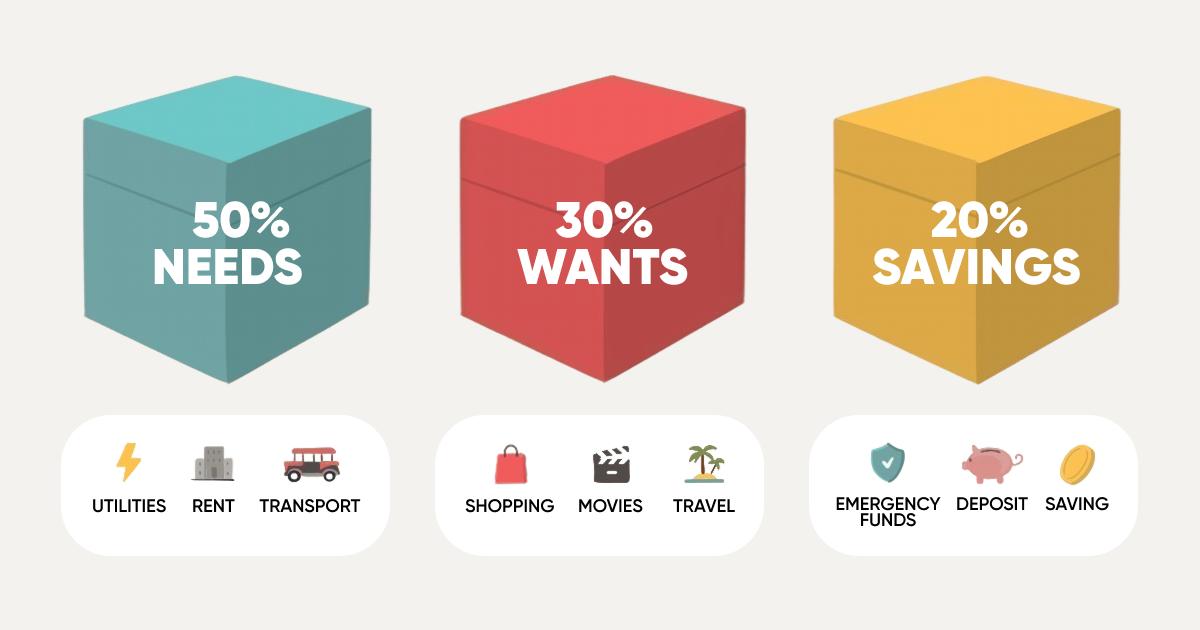
The helpful part is that you can quickly see where your money should go: the essentials first, then some room for your wants, and a portion for your savings.
The 50/30/20 rule can help if you are just starting to build a monthly budget. It can also help if you already earn regularly but still feel like your money disappears before the next payday.
It helps you see your spending habits more clearly, so you can adjust your spending based on your income, expenses, and financial goals.
How the 50/30/20 rule works
Start with your take-home pay, or the money you actually receive after required deductions, such as income tax, government contributions, or other amounts your employer deducts before your salary reaches your account.
If your gross salary is ₱35,000 but the bank account where you receive your salary gets ₱30,000, use ₱30,000 for your budget. If you budget around money you do not actually receive, you may find it harder to follow.
Once you know your take-home pay, the next step is to divide it into 3 parts:
Budget category | Share of income | What it covers |
Needs | 50% | Essential monthly expenses |
Wants | 30% | Non-essential spending |
Savings | 20% | Savings goals, an emergency fund, or money you put toward paying down debt faster |
This is the usual order of the 50/30/20 rule: needs first, wants second, savings third. People may write the numbers in a different order, such as 50/20/30, 20/30/50, or 30/20/50. The common version is still 50% for needs, 30% for wants, and 20% for savings.
What counts as needs?
Needs are expenses you must pay to live, work, study, and meet your basic responsibilities. Your needs may include:
Rent or your share of household expenses
Groceries
Electricity and water bills
Internet for work or school
Transport
Medicine and basic health needs
Insurance
Minimum debt payments
Money you regularly give to family
For many Filipino households, family support is part of the real monthly budget. If you regularly help with your parents’ expenses, a sibling’s school costs, or shared household bills, include that amount in your needs.
If you are not sure where an expense belongs, ask what happens if you skip it. If not paying for it affects your home, health, work, school, safety, or basic obligations, it likely belongsunder needs.
What counts as wants?
Wants make life more comfortable or enjoyable, but you can reduce them when needed. Your wants may include:
Food delivery
Coffee, milk tea, or other drinks bought outside
Eating out
Shopping
Streaming subscriptions
Hobbies
Weekend plans
Gadget upgrades or accessories you do not urgently need
Wants are not wrong, as a realistic budget should still leave space for your rest and enjoyment. The goal is to enjoy your wants without letting them take over your budget.
For example, food is a need, but regular food delivery may be a want. Internet may be a need if you use it for work or school. Several paid streaming subscriptions may be considered as wants. If your needs already take more than 50% of your income, start by looking at your wants and see where you can cut back.
What goes into the 20% savings category?
The 20% category in the 50/30/20 budget is for money you set aside for future expenses and goals. You may use this money for:
An emergency fund
Major savings goals
Tuition
Small business savings
Major travel goals
Money for bigger planned purchases
Additional payments for your debt, if you want to pay it down faster
Your required monthly debt payments should stay under your needs because you must pay them. But if you choose to pay more than the required amount on a loan, you can include that extra payment in the 20% category because it can help you reduce your debt sooner.
The savings part of the 50/30/20 rule helps you avoid saving only what is left. If you save only after spending, you may have nothing left by the end of the month.
If you cannot save 20% yet, start with an amount you can set aside regularly. For example, saving ₱500 every payday still counts as progress.
How to use the 50/30/20 rule step by step
Step 1: Compute or check your take-home pay amount
Check how much money actually reaches your bank account from your salary, income, or allowance. Use that amount, not your full salary before deductions.
Example:
Your gross salary: ₱35,000
Your take-home pay: ₱30,000
Set aside ₱30,000 for your 50/30/20 budget.
Step 2: List your monthly expenses
Next, list down the expenses you usually pay each month. Include both your fixed expenses and variable expenses. Fixed expenses are usually the same each month. These may include your rent, internet, loan payments, or school fees.
Variable expenses change from month to month. These may include groceries, transport, electricity, water, and other household expenses.
Step 3: Group your expenses
Review each expense and decide whether it belongs under your needs, wants, or savings.
If an expense is required, it belongs under needs. If it is optional, it likely belongs under wants. If it helps you prepare for the future, it belongs under savings.
This step can help you notice spending patterns that are easy to miss. Sometimes the problem is not one big purchase. Many small expenses can add up.
Step 4: Adjust your budget gradually
Your first budget may not match the 50/30/20 rule, and that is completely normal. It often takes a few tries to find the right split that works for your income and expenses.
For example, if your needs take 65% of your income, do not force the exact split right away. Start by reviewing your wants first, then check if you can reduce any fixed expenses over time.
50/30/20 rule example with a Philippine monthly salary
Here is how a simple 50/30/20 calculator works: multiply your take-home pay by 50%, 30%, and 20%. For example, if your monthly take-home pay is ₱30,000, here is how the split may look:
Category | Formula | Monthly amount |
Needs | ₱30,000 x 50% | ₱15,000 |
Wants | ₱30,000 x 30% | ₱9,000 |
Savings | ₱30,000 x 20% | ₱6,000 |
This means you can plan your monthly budget around these amounts:
₱15,000 for your needs
₱9,000 for your wants
₱6,000 for your savings, future goals, or additional or less urgent payments for your debt
Sample monthly budget
Here is a sample budget:
Category | Example expenses | Total |
Needs | Rent or your share of household expenses, groceries, utilities, internet, transport | ₱15,000 |
Wants | Eating out, subscriptions, shopping, hobbies, weekend plans | ₱9,000 |
Savings | Emergency fund, savings goal, extra payment toward debt | ₱6,000 |
Your budget may look different depending on where you live, how you commute, who you support, and what you are saving for.
When the 50/30/20 budget may not fit perfectly
This is where the rule becomes more flexible. The 50/30/20 rule is a useful guide for budgeting, but you do not have to follow it strictly in every situation. Your income, living costs, financial responsibilities, and savings goals can all affect how you divide your money. Use the rule as a guide, then adjust it based on your real-life budget.
In the Philippines, some expenses can take a large share of your income. Rent may be high. Groceries may change from month to month. Transport costs can depend on your location and work setup. Some people also support family members or pay school-related expenses.
If your needs already take more than 50%, adjust the split while keeping the same idea: cover essentials, reduce what you can, and save an amount you can set aside regularly.
Adjusted split | When it may fit |
60/20/20 split | When essentials are higherbut savings is still possible |
70/20/10 split | When income is tight and essentials take most of the budget |
80/10/10 split | When you want to start saving small but consistently |
Some people may also search for terms like 70/30/20 rule or the 30/20/10 rule, but these do not work as complete budget splits because they do not add up to 100%. Before following any version, check what each number means and whether the total makes sense for your income. A useful budget is one you can follow and adjust.
How students can use the 50/30/20 rule
If you are a student, the 50/30/20 rule can also help you plan a simple college or university budget.
Your income may come from an allowance, part-time work, scholarships, or family support. Your needs may include food, transport, school supplies, mobile data, and project expenses. Wants may include eating out, entertainment, shopping, and subscriptions. Savings may be for emergencies, school costs, or a planned purchase.
If you are learning how to spend money wisely as a student, start with a smaller version of the rule. Even saving ₱100 or ₱200 regularly can help you build a saving habit. What matters is saving regularly, even if the amount you set aside is small.
Common mistakes when using the 50/30/20 rule
Using your gross salary instead of take-home pay
Use the money you actually receive. If you budget based on your salary before deductions, your plan may look better than it feels.
Treating wants as needs
Some expenses feel normal because they happen often, but that does not always make them needs. Check whether the expense is required or optional.
Saving only what is left
If you save only what is left after spending, you may have nothing left. Set aside a small amount early, even if it is not yet 20%.
Copying someone else’s budget
Your budget will naturally look different from someone else’s. Your rent, transport costs, family responsibilities, debt payments, and savings goals all shape how you manage your money.
Use the budget examples above for inspiration, but adjust them to fit your own income, expenses, and financial responsibilities.
Giving up after a difficult month
Budgeting takes practice. If you go over budget, take a look at what happened and make a few adjustments for the next month.
You do not need to get the budget perfect right away. Focus on learning from each month and making small adjustments as you go.
Budgeting tips to make the rule easier to follow
Start with your actual spending. Before making big changes, track your expenses for a month so you can see what usually happens to your money.
Separate your savings from your daily spending. Keep your emergency fund or savings goals in a separate account or wallet so you are less tempted to spend them.
Review small recurring charges. Subscriptions, delivery fees, and small online purchases can quietly add up.
Plan for irregular expenses. Gifts, repairs, school needs, and medical costs may not happen monthly, but they still affect your budget.
Keep your budget somewhere easy to check. Use a notes app, a spreadsheet, a notebook, or a budgeting app. Choose what you can maintain.
Update your budget when you get a new job, bill, debt, or family responsibility.
A simple way to start
The 50/30/20 rule gives every peso a general purpose: essentials, enjoyment, and future goals. To start, check your take-home pay. List your monthly expenses. Group them into needs, wants, and savings. Then compare your current spending with the 50/30/20 split.
If the numbers do not fit yet, adjust slowly. Reduce one expense. Set aside a small amount every payday. If you have debt, pay more than the required amount when your budget allows.
Build your savings plan with Salmon Time Deposit. Once you know how much you can set aside, you can consider Salmon Time Deposit for savings you do not plan to use right away. Learn more about Salmon Time Deposit
Frequently asked questions (FAQs)
Is the 50/30/20 rule based on my gross income or take-home pay?
Use take-home pay because you can only budget the money you actually receive after required tax, government benefit-related, and other deductions. It gives you a more realistic starting point than gross salary.
What is the difference between needs and wants?
Needs are expenses you must pay to live, work, study, and meet basic responsibilities. Wants are expenses that add comfort or enjoyment but can be reduced if your budget is tight.
Can debt repayment be part of the 20% category?
Yes, if you choose to pay more than the required amount on a loan, you can include that extra payment in the 20% category. Your required monthly payment usually belongs under needs because it must be paid each month.
What if I cannot save 20% of my take-home pay yet?
Start with a smaller amount because a budget should fit your current situation. You can begin with 5%, 10%, or a fixed amount every payday, then increase it when your budget allows.
Is the 50/20/30 rule the same as the 50/30/20 rule?
Not always, because people may write the numbers in different orders. The common 50/30/20 rule means 50% for needs, 30% for wants, and 20% for savings and future goals.
How do I calculate the 50/30/20 rule?
Use this simple 50/30/20 rule calculator:
Take-home pay x 50% = needs
Take-home pay x 30% = wants
Take-home pay x 20% = savings
For example, if you have ₱30,000 in take-home pay, that means you should set aside ₱15,000 for your needs, ₱9,000 for your wants, and ₱6,000 for your savings.
10.06.2026