Blog
How to Compute 13th-Month Pay in the Philippines
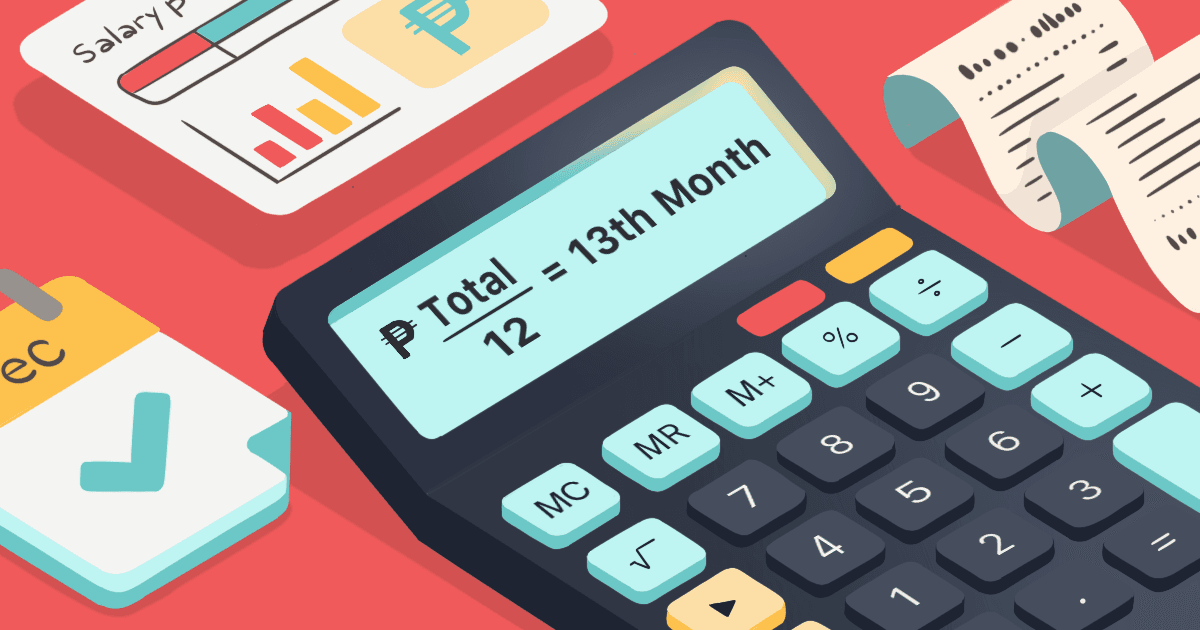
In the Philippines, receiving your 13th-month pay can make the holiday feel extra festive and joyful. According to Presidential Decree 851 (PD 851), 13th-month pay is a mandatory benefit for rank-and-file employees working in the private sector. It's computed by adding your total basic salary for the year and dividing the total by 12, and this must be given out on or before December 24.
How to calculate 13th-month pay: Formula and methods
The standard formula for 13th-month pay is:

In simple terms, it's equal to one month’s pay, but factors like unpaid leaves, proration for new hires or resigned employees, and salary adjustments may affect the amount. Basic salary is the fixed pay for your regular duties and standard hours, excluding premiums, incentives, and allowances.
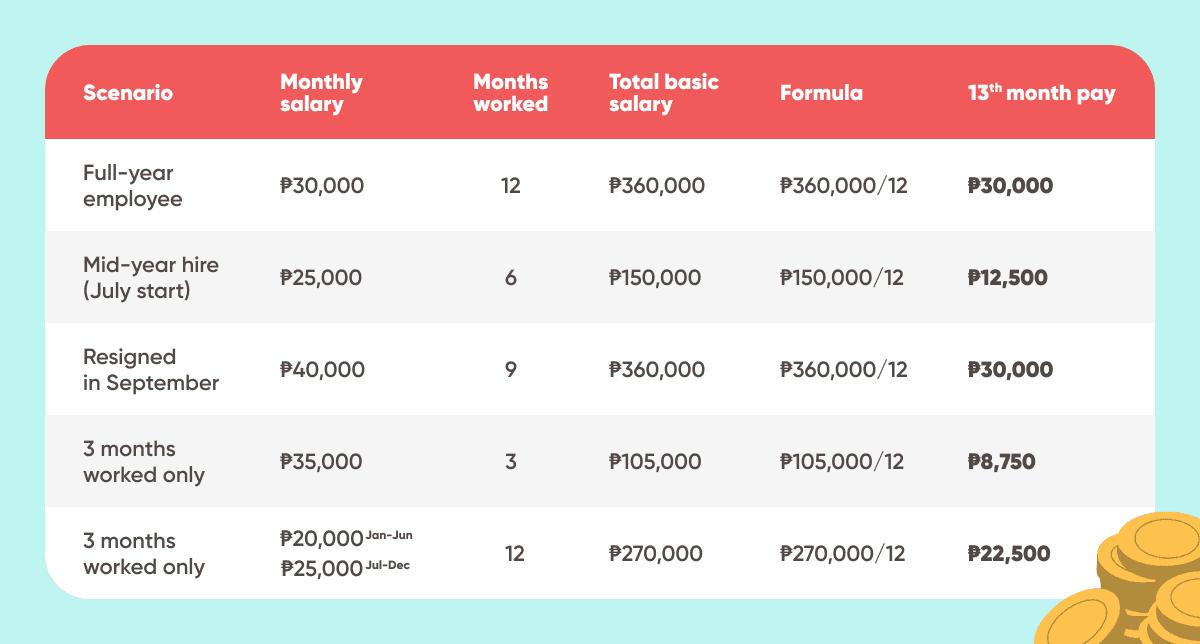
Below are examples of specific employees and their respective 13th-month pay amounts.
Who is entitled to 13th-month pay?
As stated in PD 851, rank-and-file employees in the private sector are entitled to 13th-month pay if they have worked at least one month during the calendar year, regardless of status or pay method. The benefit applies to daily, monthly, or output-based workers, full-time or part-time, and is computed solely from basic salary earned.
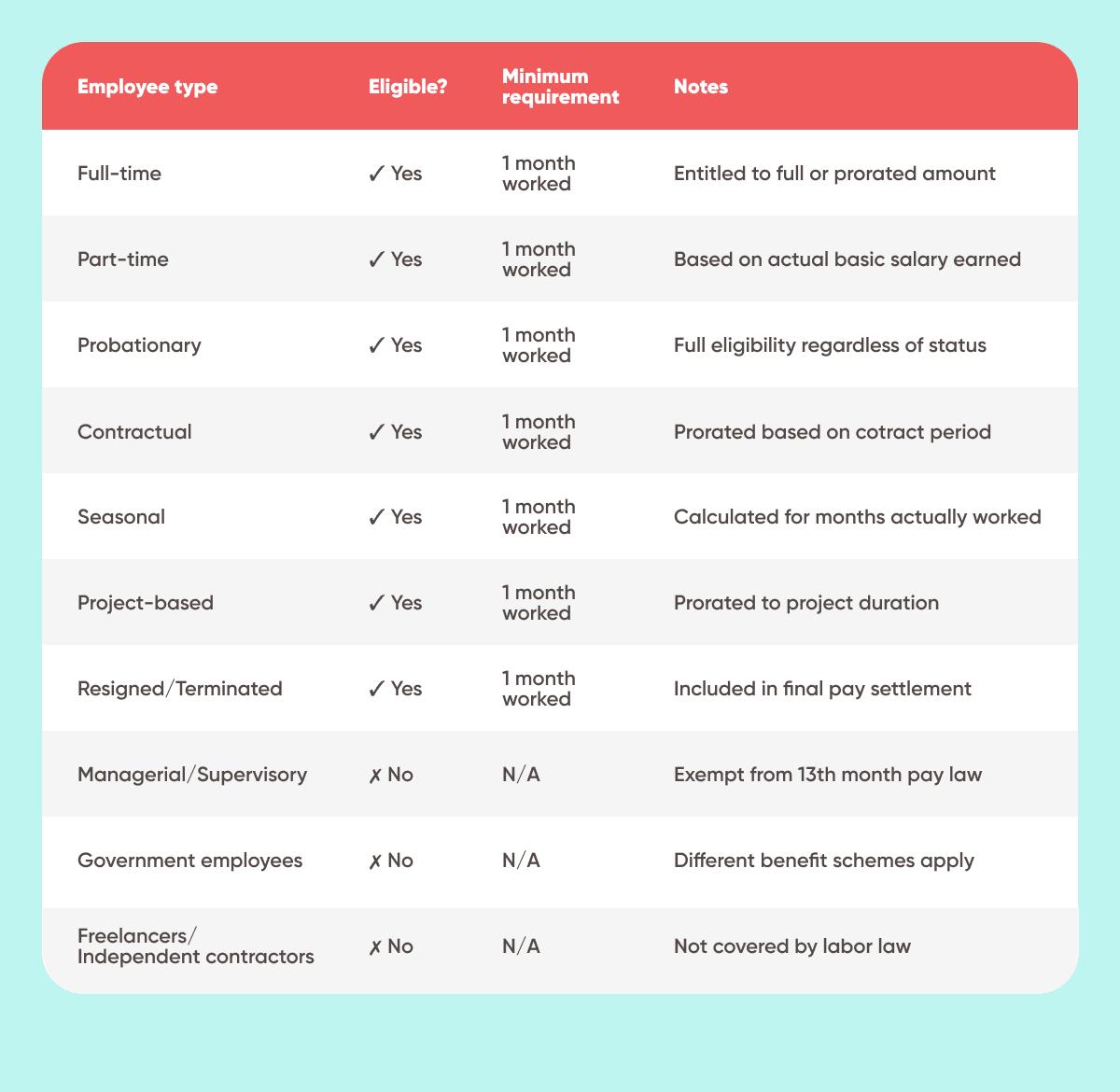
Below are examples of employee types and their eligibility.
Eligible employee types
- Full-time employees receive 13th-month pay based on their full basic salary for the year.
- Part-time, seasonal, and contractual workers qualify and receive prorated amounts based on actual basic earnings.
- Household workers are entitled under Kasambahay Law (RA 10361).
- New hires qualify after at least one month of service and receive prorated pay.
Non-Eligible Groups
- Managerial and supervisory employees are not covered because the law applies only to rank-and-file staff.
- Government workers follow separate compensation schemes.
- Freelancers and independent contractors are not considered employees under labor law.
- Pure commission and boundary workers are not covered by a fixed wage.
- Employers offering an equivalent bonus may be deemed compliant and do not require to provide 13th month pay.
When is 13th-month pay given?
You can expect to receive your 13th-month pay before December 24, though some companies release half mid-year and the rest by year-end.
What's more important is that employers must submit their 13th-month compliance report to the Department of Labor and Employment (DOLE) by January 15, with no extensions. Late payment or non-payment may lead to administrative fines, compliance orders to pay owed amounts with interest, and, in severe or repeat cases, possible work stoppage or temporary closure.
How to compute 13th-month pay with examples
As previously discussed, the standard formula for 13th-month pay is:
13th month pay = total basic salary earned for the year / 12
Included in the computation
Basic salary
This is the fixed, regular compensation an employee receives for performing their standard duties during normal working hours — the core basis of the 13th month pay formula.
Cost of Living Allowance (COLA), only if integrated into basic pay
If COLA is incorporated into basic salary through company policy or employment contracts, then it is included in the computation.
Regular salary-related benefits tied to basic pay
These are considered as basic pay that the employee is contractually or legally entitled to and not considered a premium or incentive.
Paid leaves
Examples of these include vacation leave, sick leave, bereavement leave, and service incentive leave. These leaves are based on the employee’s regular basic salary rate as they substitute for days worked.
Excluded from computation
The following are considered premiums and not a part of basic salary:
- Overtime pay
- Holiday pay
- Night shift differential
Performance bonuses, incentives, and commissions are excluded in the computation for 13th-month pay, unless they are explicitly integrated into basic salary through contract or policy. Profit sharing is a discretionary benefit and not part of a fixed wage. Allowances like transportation, meals, and others are meant to cover expenses or provide supplemental support, and therefore are not counted as fixed wages. Cash equivalent of unused leaves is not part of basic salary because they are not compensation for days worked, but rather a conversion of unused benefits.
Computation examples
1. Full-year employee with a consistent salary
- ₱30,000 per month, no unpaid leaves, and no salary changes throughout the year
Total basic salary for the year: ₱30,000 x 12 = ₱360,000
13th-month pay: ₱360,000 / 12 = ₱30,000
2. Mid-year hire
- ₱50,000 per month, hired in May, worked for 8 months from May to December
Total basic salary: ₱50,000 x 8 = ₱400,000
13th-month pay: ₱400,000 / 12 = ₱33,333.33
3. Resigned employee
- ₱40,000 per month, last day of work on August 15, worked from January to August, no unpaid leaves
A. Employee paid the full month of August
Total basic salary: ₱40,000 x 8 = ₱320,000
13th-month: ₱320,000 / 12 = ₱26,666.67
B. Employee paid only half of August
Salary for August = ₱40,000 / 2 = ₱20,000
Total basic salary: (₱40,000 x 7 months) + ₱20,000 = ₱280,000 + ₱20,000 = ₱300,000
13th-month: ₱300,000 / 12 = ₱25,000
4. Employee with unpaid leave periods
- ₱25,000 per month, 10 days of unpaid leave in July
Daily rate = ₱25,000 / 22 (total working days in July) = ₱1,136.36
Unpaid salary deduction: 10 days x ₱1,136.36 = ₱11,363.60
Salary actually earned:
- July salary = ₱25,000 – ₱11,363.60 = ₱13,636.40
- All other months: ₱25,000 x 11 = ₱275,000
Total basic salary for the year: ₱275,000 + ₱13,636.40 = ₱288,636.40
13th-month: ₱288,636.40 / 12 = ₱24,053.03
5. Variable pay employee
- Pay raise from ₱20,000 to ₱25,000, starting in July
January to June (6 months at ₱20,000): ₱20,000 x 6 = ₱120,000
July to December (6 months at ₱25,000): ₱25,000 x 6 = ₱150,000
Total basic salary earned: ₱120,000 + ₱150,000 = ₱270,000
13th-month: ₱270,000 / 12 = ₱22,500
Taxation of 13th-month pay
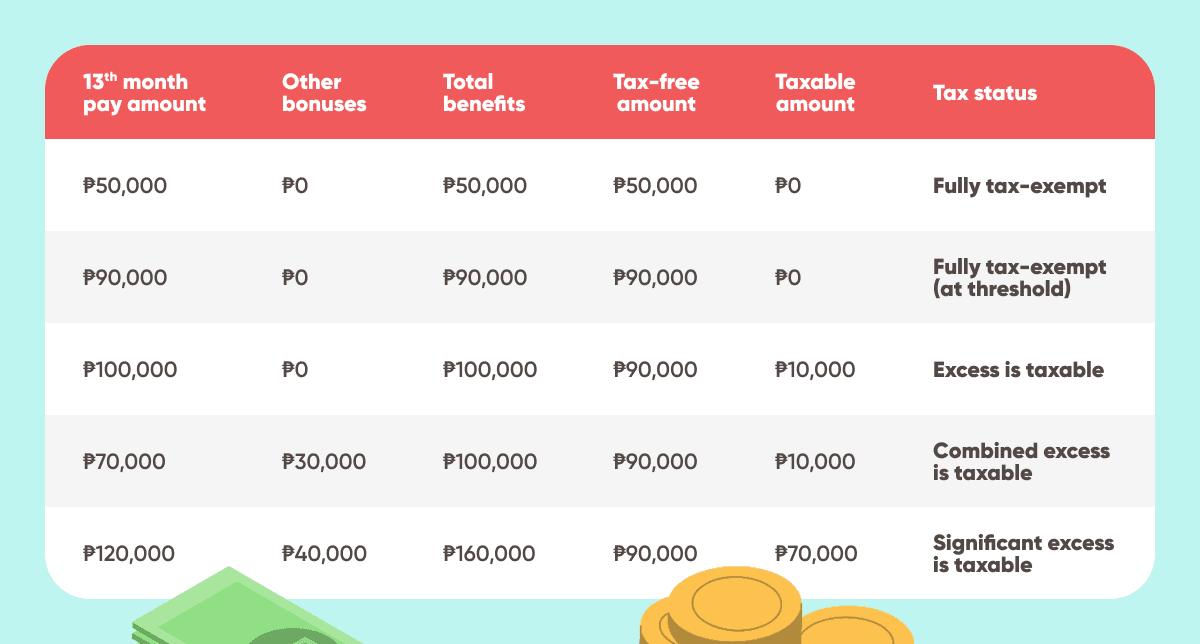
Under the TRAIN Law, the first ₱90,000 of combined 13th-month pay and other bonuses is tax-exempt. If the total bonuses exceed ₱90,000, the excess is subject to withholding tax counted as taxable income, based on the employee’s tax bracket.
Below shows different situations when bonuses are tax-exempt or taxable.
Tax Calculation Scenarios
1. Employee below ₱90,000 threshold (tax-free)
- 13th month pay: ₱30,000
- Performance bonus: ₱40,000
Total bonuses = ₱30,000 + ₱40,000 = ₱70,000
The employee does not pay tax on these bonuses.
2. Employee exceeding ₱90,000 threshold (tax on excess)
- 13th month pay: ₱60,000
Performance bonus: ₱50,000
Total bonuses = ₱60,000 + ₱50,000 = ₱110,000
Taxable bonus = ₱110,000 − ₱90,000 (tax-exempt) = ₱20,000
Withholding tax = Taxable bonus x employee's tax bracket*
Withholding tax = ₱20,000 x 20% = ₱4,000
The employee pays ₱4,000 for tax on the ₱20,000 excess above ₱90,000.
3. Combined bonuses: multiple components in one year
- 13th month pay: ₱35,000
- Christmas bonus: ₱30,000
- Mid-year bonus: ₱20,000
- Other incentive bonus: ₱15,000
Total bonuses = ₱35,000 + ₱30,000 + ₱20,000 + ₱15,000 = ₱100,000
Taxable bonus = ₱100,000 − ₱90,000 = ₱10,000
Withholding tax = Taxable bonus x employee's tax bracket*
Withholding tax = ₱10,000 x 20% = ₱2,000
The employee pays ₱2,000 for tax on the ₱10,000 excess above ₱90,000.
*The tax amount will vary depending on the employee's actual tax bracket.
Common Employee Scenarios
Proration will be applied to special situations such as the following:
Probationary, project-based, or variable pay employees
Probationary employees qualify for 13th-month pay after rendering at least one month of service, regardless if they do not finish probation or are not regularized. In computing for the bonus, they require a partial-year computation, instead of the full-year equivalent. If salary changes upon regularization, each period must be computed separately.
Project-based employees are granted 13th-month pay if they are considered rank-and-file. Instead of a January-December computation, their bonus is prorated based on the project duration, so only the basic salary earned during the project period is counted in the computation.
Variable pay employees are eligible for 13th-month pay, but only their fixed basic salary will be counted in the bonus computation. Commissions, incentives, allowances, premiums, and the like are excluded from 13th-month pay calculation, unless specified in their contract that these are integrated into their basic salary.
Employer compliance and penalties
DOLE requires employers to keep payroll records, document 13th month payments, and pay through legal methods like cash, bank credit, or payroll systems. Employers must file a 13th Month Pay Compliance Report by January 15 of the following year, which lists the amounts paid and the covered employees.
DOLE Compliance and Penalties
For employers, non-compliance may lead to fines, mandated orders to pay the benefit, legal interest on overdue amounts, possible business permit suspension, and other penalties. Furthermore, employees can file complaints regarding 13th-month pay delays or non-compliance with the National Labor Relations Commission (NLRC).
Common employer mistakes
- Including allowances in the basic salary
- Failing to prorate 13th-month pay for new or resigned staff
- Overlooking mid-year salary changes
- Delaying payment
- Miscalculating tax on bonuses
- Poor payroll record-keeping
- Lack of communication about amounts and schedules to employees
Best employer practices
In order to mitigate any unforeseen issues that may arise upon the issuance of 13th-month pay, here are some best practices for employers to prepare for the mandatory dole-out:
1. Set up a payroll calendar early in the year
Decide early on when to pay out (on or before December 24) and schedule internal cutoff periods and submission deadlines — especially for the DOLE compliance report (January 15).
2. Budget for 13th-month pay in advance
Ensure you have enough funds set aside for the mandatory bonus. This can be done by allocating funds monthly or quarterly throughout the year.
3. Maintain accurate payroll records year-round
Review your payroll records regularly to keep track of basic salary, paid leaves, unpaid absences, and rate changes to avoid errors in computation.
4. Conduct regular salary and payroll audits
Update records as needed, such as employee rate adjustments and classification changes, to ensure accurate 13th-month calculations.
5. Use automated payroll systems
Input the correct numbers and the system will handle proration and salary changes accordingly, as well as produce compliance reports and payslips without the risk of human error.
6. Communicate clearly with employees
Lead with transparency by communicating with your employees regarding their eligibility, computation, proration, and payout schedules to help manage expectations.
7. Provide detailed payslips
Show how 13th-month pay was computed, including basic salary, prorated calculations, exemptions, and deductions (if any).
Tools and resources
You may refer to the following resources to provide you with more information regarding 13th-month pay in the Philippines:
DOLE official guidelines and labor advisories
DOLE contact information
- DOLE hotline 1349 (Mondays to Fridays, 6:00 am to 10:00 pm)
- Message facebook.com/laborandemploymentph
- Email [email protected] with your name, address, contact number, and message
Free online 13th-month pay calculator
Payroll or HR software solutions (DOLE-compliant)
How Salmon can help at year-end
If you're planning to set aside your 13th-month bonus for your personal money goals, consider opening a Salmon Time Deposit that's insured by the PDIC up to ₱1 Million per depositor. Choose flexible terms from 6 months up to 5 years, and earn up to 8% per annum, depending on your deposit. Grow your savings faster and open an account today.
But if you're waiting for your 13th-month pay just to get your holiday and Noche Buena shopping on time, you might want to apply for a Salmon Product Loan. Use it as a financial buffer to shop hassle-free for gifts and party essentials at partner stores. Get approved in 1 minute to borrow up to ₱60,000 with 0% down payment. Spread the joy this Christmas and apply now.
Conclusion
In the Philippines, 13th-month pay is a mandatory benefit that's highly anticipated by Filipino employees as it provides financial support during the Christmas season. As such, the employer's responsibility to properly calculate and timely payment of 13th month pay is essential, not just to show gratitude to the staff, but to comply legally with Philippine labor laws. DOLE emphasizes that employers who fail to fulfill this mandated bonus may risk sanctions and potential legal action.
Next steps
Visit the Salmon website today to use the Product Loan calculator and estimate your borrowing limit this Christmas, or check out the Time Deposit calculator to see how much you can earn if you decide to deposit your 13th-month pay (and other bonuses). You can also download the Salmon app to browse partner stores, explore flexible payment options for holiday shopping, and manage other year-end expenses. Find out more here.
Frequently Asked Questions
Is tardiness or lateness deducted from 13th 13th-month pay?
Tardiness can affect 13th-month pay if your company implements "no work, no pay" or deducts pay for late arrivals. The reduced basic salary for that month adjusts the 13th-month computation. However, if the deduction is only disciplinary or if the company does not deduct salary for being late, the 13th-month pay is unaffected.
What is the new rule for 13th-month pay in 2025?
As of 2025, there have been no changes to 13th-month pay rules. Employers must ensure that the bonus is given out on or before December 24 and that the compliance report is submitted by January 15 of the following year. The formula and tax exemption threshold remain unchanged — that is, the first ₱90,000 of 13th month pay and other bonuses are tax-exempt, while the remaining excess (if any) is considered taxable.
Can I still get 13th-month pay if I go AWOL?
Employees who go AWOL but have worked at least one month are still legally entitled to a prorated 13th-month pay for the time actually worked. However, employers may deduct financial obligations, the value of unreturned property, or any damages for which the employee is responsible. Processing of the bonus may be delayed as AWOL staff must still coordinate with HR for clearance before release.
Can a company refuse to give 13th-month pay?
Refusal to disburse 13th-month pay to eligible rank-and-file employees is illegal. Only managers or supervisors (as defined by DOLE), government workers, and employees already receiving an equivalent benefit are exempt. Eligible but neglected employees may file complaints with DOLE or the NLRC. Meanwhile, employers risk fines, compliance orders, legal interest, and other penalties for non-payment.
What is the difference between 13th and 14th-month pay?
13th-month pay is mandatory under PD 851 for all eligible private-sector employees in the Philippines. A 14th-month pay is a discretionary benefit and is offered only by some employers or industries. It has no legal basis in local labor law and is neither required for compliance nor automatically tax-free unless treated as a separate bonus.
How is back pay calculated with 13th-month pay?
Back pay (or final pay) is the amount an employee receives upon termination or resignation. It includes a series of additions or deductions depending on their obligations to the company. The prorated 13th month is included in back pay and computed as: total basic salary earned in the year / 12.
15.12.2025